The Government Commands, but the People Remain Sovereign
Walter Denton Smith’s Handbook of Elementary Law, 2nd ed. (1939) the book states that sovereignty ultimately rests with the people and distinguishes the state from the governmental machinery created to administer it.
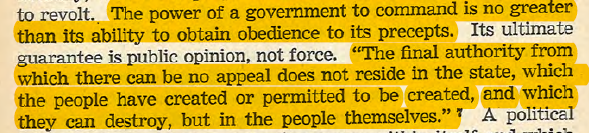
“The power of a government to command is no greater than its ability to obtain obedience to its precepts. Its ultimate guarantee is public opinion, not force.”
“The final authority from which there can be no appeal does not reside in the state, which the people have created or permitted to be created and which they can destroy, but in the people themselves.”
These words express one of the oldest and most important tensions in political government: the difference between power and authority.
A government possesses institutions. It has legislatures, courts, agencies, police departments, administrative bodies, taxing authorities, and military forces. Those institutions give government an enormous capacity to act.
But capacity is not the same thing as sovereignty.
The deeper question is: From where does governmental authority originate?
In the American constitutional tradition, the answer begins with three words:
We the People.
Government is not presented as the creator of the people. The constitutional theory runs in the opposite direction. The people establish the governmental structure, delegate powers to it, divide those powers among institutions, and impose limits upon their exercise.
The Supreme Court described this principle in McCulloch v. Maryland in 1819, explaining that the Constitution was submitted to the people and derived its authority from them. The Court rejected the proposition that the federal government existed independently of that popular foundation.
That distinction matters.
Government Is an Instrument, Not the Source
Walter Denton Smith's Handbook of Elementary Law made the distinction particularly clear. It described the “state” as an organized political society while describing “government” as the agencies through which laws are made, applied, and enforced. The same work characterized the federal government as one possessing delegated powers rather than unlimited inherent authority.
This provides a useful way to understand constitutional government.
Government is machinery.
The Constitution establishes the machinery.
The people are the source from which the authority to establish that machinery originates.
The machine may exercise enormous power, but it does not logically become the creator of the authority from which its own existence derives.
That idea appears repeatedly in American constitutional law. In Hepburn v. Griswold, the Supreme Court stated that through the Constitution the people created a government, defined its powers, prescribed their limits, and distributed those powers among different departments. The Court emphasized that governmental departments possess only the powers delegated to them.
The distinction therefore is not merely rhetorical.
It is structural.
The Difference Between Force and Legitimacy
Government can compel conduct through penalties, fines, imprisonment, taxation, regulation, and other lawful enforcement mechanisms.
But enforcement alone does not explain why a political system survives.
No government can place an officer beside every person, inside every home, at every business, and on every road.
Most laws are followed without the immediate presence of government force.
That reality gives meaning to Smith's statement:
“Its ultimate guarantee is public opinion, not force.”
A functioning legal system depends heavily upon widespread voluntary compliance, institutional trust, social expectations, and acceptance of lawful authority. Force exists behind the system, but force cannot practically perform every function of government every moment of every day.
This is why legitimacy matters.
A government whose population broadly accepts its institutions requires comparatively little direct coercion to maintain ordinary social order. A government that loses widespread acceptance may possess extraordinary coercive resources while simultaneously becoming politically unstable.
Authority therefore contains an element that cannot simply be manufactured by possessing weapons, courts, buildings, titles, or statutes.
It requires acceptance.
Popular Sovereignty Does Not Mean That Every Individual Is Above the Law
There is also an important distinction that must not be lost.
The principle that political sovereignty ultimately rests with the people does not mean that each individual person may unilaterally decide which laws bind him.
Under the constitutional system, the people exercise political sovereignty collectively through constitutions, elections, legislation, amendments, juries, courts, political organization, petition, speech, and other lawful mechanisms.
John Locke recognized a similar distinction centuries earlier. His political philosophy placed ultimate political authority with the people while simultaneously recognizing that organized civil society necessarily establishes institutions capable of making binding decisions.
Popular sovereignty therefore should not be confused with individual sovereignty from every law.
The principle is broader.
It means that government itself is subordinate to the constitutional order from which its authority originates.
Officials are not sovereign merely because they hold office.
Agencies are not sovereign merely because they issue regulations.
Legislatures are not sovereign merely because they enact statutes.
Courts exercise enormous constitutional authority, but they too exist because a constitutional system establishes their jurisdiction.
Political offices are temporary.
Institutions are creations of law.
The people remain.
Constitutional Government Assumes Limited Power
This principle is especially important because constitutionalism is built around distrust of unlimited governmental power.
The Supreme Court has stated that American government is fundamentally opposed to depositing unlimited power anywhere. Legislative, executive, and judicial institutions possess defined powers rather than unlimited ones.
That is why constitutions contain limits.
That is why powers are divided.
That is why officials take oaths to constitutional law rather than requiring the population to swear personal allegiance to individual officeholders.
That is why elections occur.
That is why amendments exist.
That is why courts review governmental action.
That is why citizens may criticize officials.
And that is why peaceful political opposition is not inherently an attack upon constitutional government. It is part of the mechanism through which constitutional government operates.
A system based upon popular sovereignty necessarily recognizes that government may be questioned because government is not the ultimate source of its own authority.
Consent Is More Powerful Than Command
There is a tendency to imagine power vertically:
Government commands.
The individual obeys.
But that picture is incomplete.
Government can command because institutions exist to implement its commands. Those institutions function because thousands or millions of people participate in them. Legislators legislate. Judges adjudicate. Officers enforce. Clerks process records. Taxpayers fund operations. Businesses comply with regulations. Citizens serve on juries. Voters select representatives.
Political power therefore depends upon vast networks of human cooperation.
Remove enough cooperation and governmental power becomes increasingly difficult to exercise.
That does not mean political disputes should be resolved through disorder or violence. Constitutional systems specifically create peaceful mechanisms for changing laws, replacing officials, challenging governmental actions, amending governing documents, and reshaping institutions.
The ballot, petition, public debate, peaceful assembly, litigation, constitutional amendment, jury service, public records, and political organization all represent ways in which popular sovereignty operates without the destruction of civil order.
The important point is simpler:
Command alone is not sovereignty.
The People Created the Institution
Government possesses authority.
But governmental authority has a source.
In American constitutional theory, that source is not a king, an agency, a legislature, a judge, a governor, or a president.
It is the political community from which constitutional authority originates.
That is what gives Smith's words their continuing significance:
“The final authority from which there can be no appeal does not reside in the state ... but in the people themselves.”
The statement does not erase courts.
It does not erase statutes.
It does not eliminate legitimate enforcement authority.
It identifies something more fundamental.
Courts interpret law because a constitutional system gives them jurisdiction.
Legislatures enact laws because constitutions give them legislative power.
Executives enforce laws because constitutional and statutory structures assign them that responsibility.
Government officials exercise authority temporarily.
The governmental institutions themselves may endure for generations.
But neither officials nor institutions created the political authority upon which the entire structure rests.
The order of authority remains:
The people create the constitutional order.
The constitutional order creates government.
Government exercises delegated authority.
Reversing that order fundamentally changes the relationship between government and the governed.
The central principle of popular sovereignty is therefore not that government possesses no power.
Government possesses tremendous power.
The principle is that governmental power is derived power.
And that distinction separates a government that claims authority over the people merely because it can command them from a constitutional government that recognizes the source from which its authority came.